
What Makes Glow-in-the-Dark Signs Glow? A Look at the Materials and Technology
Walk past a shuttered pharmacy or a closed petrol bunk late at night, and there’s a decent chance the exit sign or the storefront lettering is still visible, glowing faintly even with every other light switched off. Most people notice it without ever wondering how it actually works. It isn’t magic, and it isn’t electricity either, at least not directly. This piece looks at the science behind glow-in-the-dark signage, the materials that make it possible, and where this technology actually earns its place alongside more common options like LED sign boards in Chennai and standard illuminated displays.
The Science That Underlies the Glow
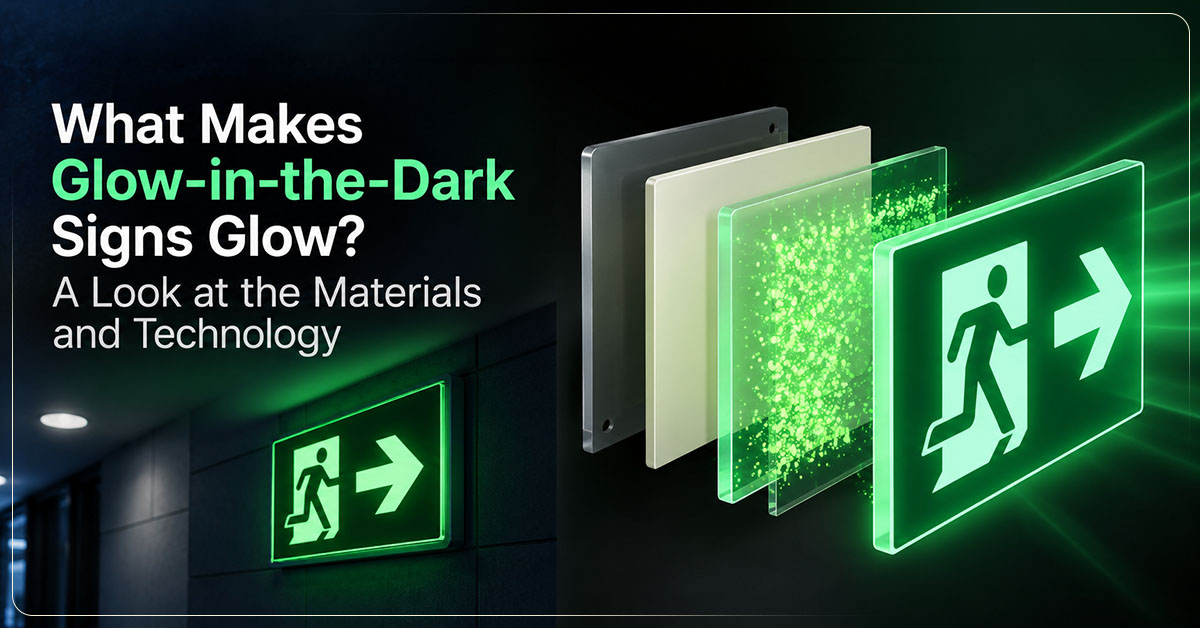
Glow-in-the-dark signs are based on a phenomenon called photoluminescence, which is a type of phosphorescence. When exposed to a light source, some materials absorb energy from light, and then slowly release that energy over time as visible light. That’s the entire mechanism behind why a glow sign appears to shine even after the lights go out.
This is fundamentally different from fluorescence, the effect used in some novelty products, where light is emitted only while the material is actively being exposed to a light source. Phosphorescent materials, by contrast, keep glowing well after that light source disappears, sometimes for several hours depending on the material used.
At a molecular level, the electrons within the phosphor compound absorb energy from incoming light and jump to a higher energy state. Instead of releasing that energy immediately, as fluorescent materials do, phosphorescent compounds hold electrons in that excited state briefly before releasing the energy gradually as visible light. That delayed release is precisely what creates the slow, sustained glow people associate with these materials, rather than an instant flash that fades the moment the light source is removed.
The Materials That Make It Possible
The glow itself comes down to a specific category of compounds known as phosphors, and the choice of phosphor material has changed considerably over the decades.
- Zinc sulfide was the original phosphorescent material used widely through much of the twentieth century, though it fades relatively quickly and requires frequent recharging under light
- Strontium aluminate is the material behind most modern glow signage, offering significantly brighter glow and a much longer duration, often outperforming older materials by ten times or more
- Rare earth dopants, elements like europium and dysprosium, get added in small quantities to strontium aluminate to enhance both brightness and glow duration
- Radioactive tritium, used in specialised, permanently glowing signage like certain emergency exit markers, works differently entirely, relying on a small amount of radioactive decay rather than light absorption
Most commercial and safety signage today relies on strontium aluminate-based compounds, since they deliver the strongest, longest-lasting glow without any of the regulatory complexity that comes with radioactive materials.
How the Glow Actually Gets Charged
Photoluminescent materials need a “charging” period, exposure to a sufficient light source, before they can glow effectively in darkness. Both natural sunlight and standard artificial lighting can charge these materials, though the intensity and duration of exposure directly affects how bright and how long the resulting glow will last.
This is an important practical consideration for businesses considering glow signage. A sign installed in a dim, poorly lit corridor will charge weakly and glow correspondingly less, regardless of how good the underlying phosphor material is. Placement and ambient lighting conditions matter just as much as material quality.
The Practical Use of Glow-in-the-Dark Signage
Glow signage, though flashy, has some practical uses in the real world beyond its aesthetic appeal.
- Emergency exit signage is still one of the most critical uses, where visibility during a power failure can be a matter of life or death.
- Safety markings in industrial or dimly lit areas, stairwells, hallways and hazard warnings benefit from glow capabilities when normal lighting is unavailable.
- Wayfinding in dimly lit venues, movie theaters, theaters and some hospitality spaces employ subtle glow features to direct traffic without interrupting the mood.
- Decorative and branding uses, where businesses want a unique, memorable visual element that traditional illuminated signage doesn’t provide.
For safety-critical uses in particular, glow-in-the-dark features often serve as a backup system in conjunction with primary lighting, ensuring visibility persists even in the event of electrical failures when LED or neon signage would simply go out.
Comparing Glow Signage to Other Illuminated Options
It’s worth understanding how phosphorescent signage stacks up against more common illuminated signage types, since each serves a distinctly different purpose.
|
Factor |
Glow-in-the-Dark Signage |
LED Signage |
|
Power source |
None, relies on charged light energy |
Requires continuous electrical power |
|
Performance during power outage |
Continues glowing |
Goes dark immediately |
|
Content flexibility |
Fixed, single static design |
Dynamic, supports colours, animation, changing messages |
|
Brightness control |
Fades gradually after charging |
Consistent, adjustable brightness |
|
Best suited for |
Safety, emergency exits, backup visibility |
Everyday branding, advertising, real-time updates |
|
Maintenance |
Needs periodic light exposure to “recharge” |
Needs stable power supply and occasional bulb/panel servicing |
Neither technology replaces the other outright. Many businesses and facilities use both, LED for everyday visibility and branding, phosphorescent glow elements specifically for safety and emergency scenarios where power reliability can’t be guaranteed.
Putting the Science to Practical Use
Not every business needs glow-in-the-dark signage, but for facilities with safety obligations, or businesses looking for a distinctive visual element that works even without power, understanding the material science behind it helps set realistic expectations. A sign that hasn’t been charged properly, or one made with lower-grade phosphor material, will underperform regardless of how well it’s installed.
Hitech Vision has spent decades working with Chennai businesses on signage that actually performs the way it’s meant to, matching material choice and technology to what a specific application actually requires. Whether a business is exploring safety-critical glow elements or considering a more traditional, permanent option like name board makers in Chennai built to last well beyond a passing trend, getting the underlying technology right from the start makes all the difference in how well a sign performs when it matters most.